
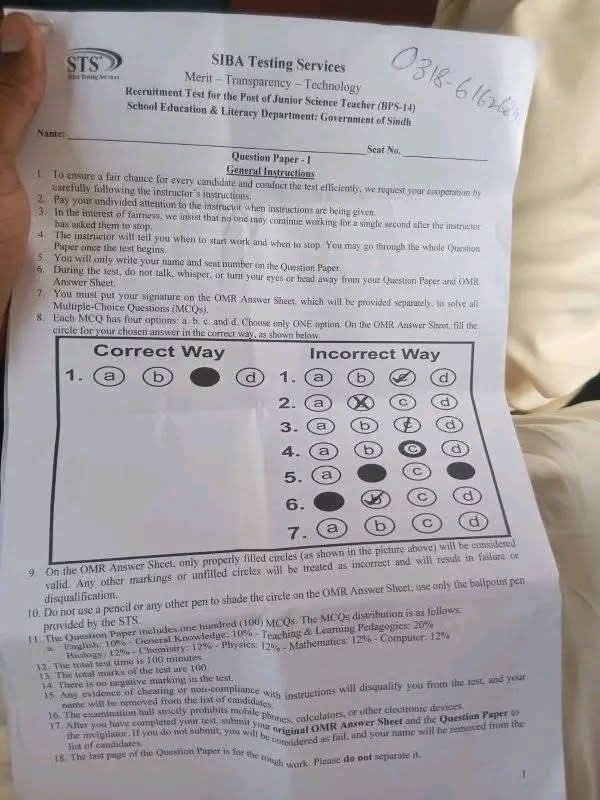
STS JST (BPS-14) Original Solved Paper
Part I: English
1. The theme of the first paragraph is about:
(a) Segregation of African and Americans
(b) Discrimination inflicted by Americans
(c) Deprivation of basic rights of Africans
** (d) African and Americans harmony**
2. The theme of the second paragraph is about:
(a) Character, justice and hope
(b) Freedom, equality and peace
(c) Vision, judgement and slavery
(d) Equality, hostility and struggle
3. Had there been a violence call by Martin, then there would have been:
(a) Chaos and less support from people
(b) Rise in credibility
(c) Dominancy over people
(d) Harmony in both nations
4. The last sentence is about:
(a) Human rights globally
(b) Human rights in the US
(c) Human rights of Black citizens
(d) Human rights locally
5. The girl who used to be very vociferous does not talk much anymore. (Meaning):
(a) Vehement
(b) Deep
(c) Silent
(d) High/Loud
6. Identify the adjective from the given sentence: “What book are you reading in the library?”
(a) What
(b) book
(c) reading
(d) library
7. Identify the sentence with correct punctuation:
(a) He said to me “he listens music every night.”
(b) He said to me, he listens music every night.
(c) He said to me, “he listens music every night.”
(d) He said to me, “he listens music every night”
8. Change into Future Perfect Continuous: “You have been working with him since noon.”
(a) You will be working with him since noon.
(b) You have working with him since noon.
(c) You will have working with him since noon.
(d) You will have been working with him since noon.
9. Change the Voice: “He was driving a car with his family from the village to the city during the rain.”
(a) A car was being driven by him with his family from the village to the city during the rain.
(b) A car was driving by him with his family from the village to the city during the rain.
(c) A car was driven by me with his family from the village to the city during the rain.
(d) A car is driven by him with his family from the village to the city during the rain.
Part III: Teaching & Learning Pedagogies
(Note: Questions 11-23 were General Knowledge/Social Studies as per syllabus)
24. A teacher notices a student remembers diagrams well but forgets spoken instructions. Which adaptation fits the student’s learning style?
(a) Provide more text-based notes
(b) Offer more physical activities
(c) Use colour-coded visual aids
(d) Increase oral presentations
25. Vygotsky’s concept of the Zone of Proximal Development refers to:
(a) Skills children can perform with guidance
(b) Skills children can perform independently
(c) Unlearned reflexive behaviours
(d) Tasks beyond a child’s capacity
26. A child who is shorter than peers but shows a normal growth rate over time is most likely:
(a) Experiencing a normal growth variation
(b) Malnourished
(c) Physically delayed
(d) In need of medical intervention immediately
27. In lesson planning, Bloom’s Taxonomy is primarily used to:
(a) Arrange students into groups
(b) Define learning objectives
(c) Prepare classroom rules
(d) Select teaching aids
28. The correct sequence for lesson planning is:
(a) Activities $\rightarrow$ SLOs $\rightarrow$ Assessment
(b) SLOs $\rightarrow$ Activities $\rightarrow$ Assessment
(c) Assessment $\rightarrow$ Activities $\rightarrow$ SLOs
(d) Activities $\rightarrow$ Assessment $\rightarrow$ SLOs
29. The use of praise, nods, and encouraging words by a teacher refers to:
(a) Reinforcement skill
(b) Probing skill
(c) Closure skill
(d) Introduction skill
30. A teacher asks follow-up questions to deepen a student’s response, which refers to:
(a) Stimulus variation
(b) Probing skill
(c) Demonstration skill
(d) Non-verbal communication skills
31. A quick quiz given at the end of a lesson to check for student understanding is best described as:
(a) A summative assessment
(b) A formative assessment
(c) A diagnostic assessment
(d) A standardized assessment
32. Feedback is information about a student’s progress toward reaching a goal(s). The following are all good sources of Feedback EXCEPT:
(a) Teacher, parent
(b) Peer, book
(c) Self, experience
(d) Vague comments
35. Flipped Learning is a:
(a) A theory of behaviour
(b) A model of instructional design
(c) A pedagogical approach that inverts conventional classroom learning
(d) A theory of cognition
36. Blended Learning is:
(a) Digital approach for M-learning in instructional design
(b) Combines online educational materials and opportunities for interaction online with traditional place-based classroom methods
(c) Conventional notion of classroom-based learning
(d) Traditional pedagogical method and approach
Part IV: Biology
41. If the checkpoints regulating cell division are altered, the person will most likely get:
(a) Hypertension
(b) Cancer
(c) Diabetes
(d) Cataract
44. The non-protein part of a conjugate enzyme, if loosely attached, is called:
(a) Co-factor
(b) Active Site
(c) Prosthetic group
(d) Inhibitor
45. A scientist observes a cell with proper ATP production but unassembled proteins. The organelle most likely dysfunctional is:
(a) Mitochondria
(b) Golgi Apparatus
(c) Endoplasmic Reticulum
(d) Ribosome
46. The process that takes place on the inner membrane of mitochondria is:
(a) Glycolysis
(b) Electron transport chain
(c) Production of Pyruvate
(d) Decarboxylation of the Acetyl group
Part V: Chemistry
53. X-rays are produced when cathode rays strike on:
(a) Non-Metal
(b) Metal
(c) Material
(d) Gas
54. The diagram shows how particles change when a substance changes state. Which change is shown?
(a) Boiling
(b) Condensation
(c) Evaporation
(d) Sublimation
55. Which mass of magnesium oxide is formed when $21.0\text{g}$ of magnesium carbonate ($M_r=84$) are completely decomposed?
(a) $1.9\text{g}$
(b) $4.0\text{g}$
(c) $10.0\text{g}$
(d) $40.0\text{g}$
57. In a Redox (Oxidation-Reduction) reaction, electrons are transferred from:
(a) Oxidizing agent
(b) Reducing agent
(c) Catalyst
(d) Inert Gas
Part VI: Physics
65. A force of $20\text{N}$ is applied to a body of mass $5\text{kg}$. What will be its acceleration?
(a) $2\text{ m/s}^2$
(b) $4\text{ m/s}^2$
(c) $10\text{ m/s}^2$
(d) $100\text{ m/s}^2$
66. The unit of Momentum is:
(a) $\text{kg m/s}^2$
(b) $\text{kg m/s}$
(c) $\text{N m}$
(d) Joule
71. The speed of sound is maximum in:
(a) Air
(b) Water
(c) Vacuum
(d) Steel
Part VII: Mathematics
78. If a pizza is divided into 10 slices and you eat 4, the percentage you did NOT eat is:
(a) $20\%$
(b) $30\%$
(c) $40\%$
(d) $60\%$
83. The endpoints of the diameter are A(-5, 6) and B(3, -4). The centre is:
(a) (1, -1)
(b) (-1, 1)
(c) (-2, 2)
(d) (2, -2)
Part VIII: Computer
89. Which of the following is NOT a web design tool?
(a) WordPress
(b) Figma
(c) Wix
(d) Oracle
90. The OSI model is a conceptual model with ______ layers.
(a) 5
(b) 7
(c) 4
(d) 6
92. Which of the following is a branch of Artificial Intelligence?
(a) Programming
(b) Machine learning
(c) Deep thinking
(d) Microprocessors
95. Which of the following could be a line of code from Machine Language?
(a) print(“Hello world”)
(b) cout<<“Hello world”
(c) Move I, A
(d) 10101110111101111
97. To uniquely identify a record in a table we need a ______ key.
(a) Foreign key
(b) Composite key
(c) Primary key
(d) Table key
100. The five main components of a communication system are:
(a) Message, sender, receiver, medium, protocol
(b) Message, sender, receiver, network, wire
(c) Sender, receiver, protocol, signal, computer
(d) Sender, receiver, wire, signal, computer