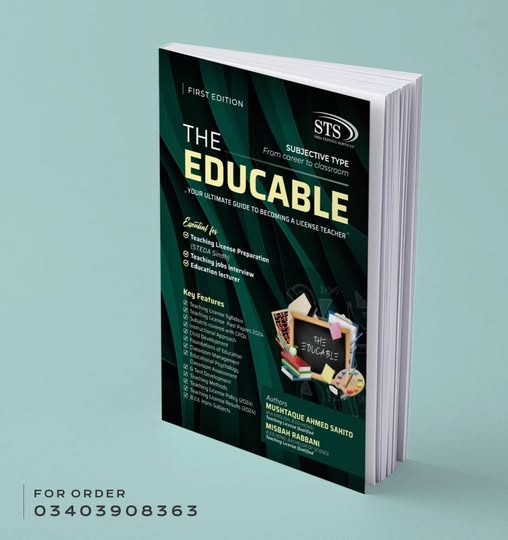
🎯 Teaching License Test Preparation
Pre-Assessment — Pedagogy & Teaching Practice (Automated Evaluation & Feedback)
Candidate Registration & Credentials
Pedagogy is the knowledge, methods, and strategies used by a teacher to help students learn effectively. It includes how a teacher plans a lesson, explains concepts, asks questions, manages the classroom, and assesses students’ learning. Good pedagogy focuses on students’ needs, abilities, and learning levels. For example, while teaching fractions, a teacher can use fraction cards, diagrams, and group activities instead of only explaining the topic through lecture. This helps students understand the concept through active participation and practical learning.
A lesson plan is a written plan prepared by a teacher before teaching a lesson. It provides a clear direction for the teaching-learning process and helps the teacher achieve the intended learning outcomes. Important components include: 1) Learning objectives/SLOs, 2) Teaching methods/activities, 3) Resources/materials, and 4) Assessment methods.
A learning objective is a clear statement describing what students should be able to know, understand, or do after completing a lesson. It should be specific and measurable. Example: “By the end of the lesson, students will be able to explain the process of photosynthesis and identify its main requirements.”
Formative assessment is an ongoing assessment used during teaching and learning to check students’ understanding and provide feedback. Examples include oral questioning during a lesson, short quizzes, exit tickets, or group observations.
Constructivism is a learning theory stating that learners actively construct their own knowledge through experience, interaction, and prior knowledge. A teacher applies it by acting as a facilitator and offering opportunities for exploration, discussion, and problem-solving.
1) Use real objects/concrete materials (paper strips, fruits), 2) Use visual models (number lines, pie diagrams), and 3) Collaborative group matching activities with fraction cards.
1) Activate prior knowledge with guiding questions, 2) Conduct a practical observation/demonstration with real plants, and 3) Have students work in groups to draw and present a labelled photosynthesis flowchart.
1) Pre-reading: Vocabulary pre-teaching & picture prediction, 2) While-reading: Guided reading with margin notes/questions, and 3) Post-reading: Pair-summarization and comprehension questions.
| Questions | Area | Cognitive Level |
|---|---|---|
| Q1 | Basic Pedagogy | Knowledge + Understanding |
| Q2 | Lesson Planning | Knowledge |
| Q3 | Learning Objectives | Understanding |
| Q4 | Formative Assessment | Understanding |
| Q5 | Constructivism | Understanding + Application |
| Q6 | Mathematics Pedagogy | Application |
| Q7 | Science Pedagogy | Application |
| Q8 | English Pedagogy | Application |
Assessment Evaluation Scorecard
Question-wise Scoring & Keyword Analysis
| Q# | Max Marks | Earned Score | Keyword Match Count | Evaluation Performance |
|---|
📋 Admin Panel: Recorded Candidate Attempt Log
This section automatically logs candidate details, qualification, score, performance rating, and attempt count dynamically.
| Attempt # | Name | Roll No | B.Ed Degree | Score | Rating | Timestamp |
|---|---|---|---|---|---|---|
| No test responses recorded yet. Fill candidate details and click submit. | ||||||